Magnesium Deficiency: Symptoms, Differential Diagnosis and Solutions
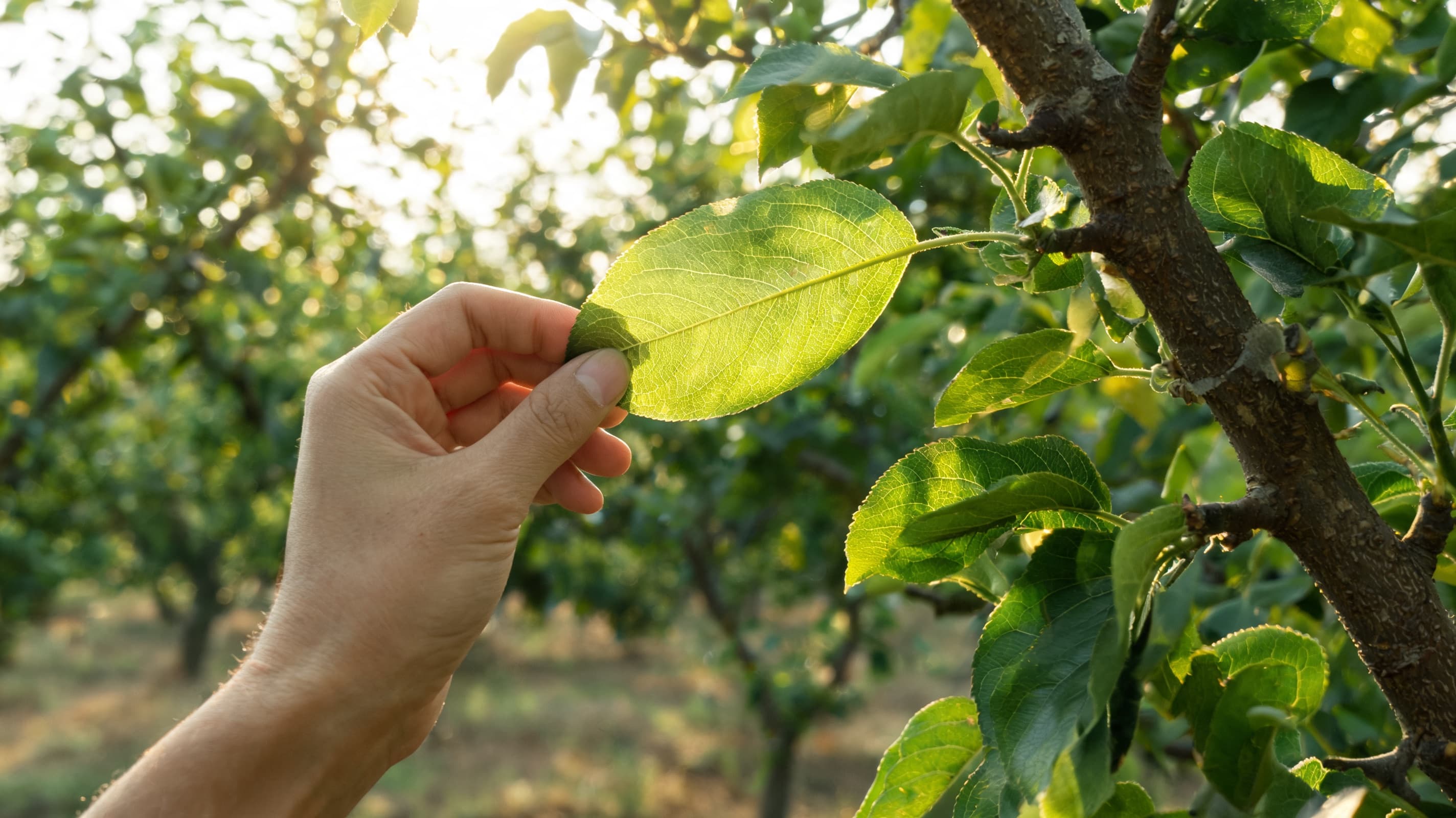
You walk into the orchard and the leaves on the lower branches catch your eye. The leaf has yellowed, but not entirely. The veins are still distinctly green while the tissue between them has turned yellow. From a distance the leaf looks like a fish skeleton.
The young leaves at the top, meanwhile, look perfectly healthy.
This is one of the most recognisable pictures in plant nutrition, and it almost always points in one direction: magnesium.
On the Markka blog we have covered calcium, potassium, iron, zinc and boron deficiencies separately. This article completes the series with magnesium, because magnesium is often not the element that ran short on its own, but the element that ran short because you applied too much of another.
What does magnesium do?
Magnesium's most critical role in the plant can be stated in one sentence: at the very centre of the chlorophyll molecule sits a magnesium atom.
Chlorophyll is the pigment that gives the leaf its green colour and drives photosynthesis. If the central atom is missing, the molecule cannot be built. This is why the first and most visible consequence of magnesium deficiency is loss of colour.
Magnesium has other roles as well:
- Enzyme activation. A large number of enzymes in the plant require magnesium in order to function. A significant proportion of these are involved in the transport of phosphorus within the plant and in energy transfer.
- Phosphorus carrier. Magnesium facilitates the movement of phosphorus within the plant. Magnesium deficiency can therefore impair phosphorus use even where the soil holds sufficient phosphorus.
- Sugar transport. It plays a role in moving the carbohydrates produced in the leaf to the plant's other organs.
- Protein synthesis. It is required for the structural integrity of ribosomes.
In short, magnesium is the element that keeps the leaf green and delivers the energy that greenery produces to the rest of the plant.
Symptoms: interveinal yellowing on older leaves
Magnesium is a mobile element. When the plant runs into difficulty it strips magnesium from older leaves and moves it to the young, growing leaves. This is the key to diagnosis.
The typical progression observed in the field is as follows:
- Interveinal chlorosis on lower and middle leaves. The main vein and the lateral veins stay distinctly green while the tissue between them yellows. The leaf takes on a fish-skeleton appearance.
- The yellowing advances inward from the leaf margin and tip. The areas along the veins are the last to be affected.
- Reddish, purplish or bronze tones in some species. In grapevine, some vegetable species and potato in particular, anthocyanin-related colouring may appear instead of or alongside the yellowing.
- Necrosis at an advanced stage. The yellowed areas dry out, turn brown and the tissue dies.
- Early leaf drop. Lower leaves fall prematurely. This can leave fruit exposed to sunburn.
The symptom begins on the lower leaves and moves upward. Yellowing at the bottom while the top is still green is the most characteristic signature of magnesium.
Differential diagnosis: what it resembles and what it is not
Leaf yellowing can arise from many causes. A wrong diagnosis means the wrong fertiliser and lost time. The table below makes field diagnosis easier.
| Symptom | Which leaves | Appearance | Likely cause |
|---|---|---|---|
| Interveinal yellowing, veins green | Older, lower leaves | Fish-skeleton look, margin inward | Magnesium deficiency |
| Interveinal yellowing, veins green | Young, top leaves | Fine green vein network, pale yellow background | Iron deficiency |
| Interveinal yellowing, wide green vein band | Young and middle leaves | Yellowing paler and more diffuse | Manganese deficiency |
| Margin scorch, not interveinal | Older, lower leaves | Brown drying from margin inward | Potassium deficiency |
| Whole leaf yellows uniformly | Older, lower leaves | No vein distinction, general pallor | Nitrogen deficiency |
| Deformation and tip death on young leaves | Young, growing point | Shape distortion rather than yellowing | Calcium or boron deficiency |
Three rules are enough to keep in mind:
- Older leaf or young leaf? If it starts on older leaves, a mobile element is involved (magnesium, potassium, nitrogen); if on young leaves, an immobile element (iron, zinc, calcium, boron).
- Interveinal or margin? Interveinal yellowing points to the magnesium and iron group; margin scorch to potassium.
- Do the veins stay green? If they do, magnesium or iron; if not, nitrogen.
Even so, visual diagnosis is always a hypothesis. Iron chlorosis and magnesium deficiency can occur together in the same orchard, and the picture can become confused on calcareous soils. We examined the particular course of iron chlorosis on calcareous soil in a separate article. For a firm conclusion, soil analysis and leaf analysis are evaluated together.
Conditions that trigger deficiency
Magnesium deficiency usually arises not because there is no magnesium in the soil, but because the plant cannot reach it. The principal triggers are as follows.
1. Sandy, light-textured soils. Because cation exchange capacity is low, magnesium is not retained. Rainfall and irrigation leach it below the root zone. This is the most commonly seen picture on such soils.
2. Acidic soils. Magnesium leaching accelerates at low pH. High hydrogen and aluminium saturation also makes it harder for magnesium to hold on exchange surfaces.
3. Excess potassium application. This is the most frequently encountered and most often overlooked cause in the field. Potassium and magnesium compete with one another for uptake at the root surface. In an orchard running an intensive potassium programme for fruit quality, the plant may be unable to take up magnesium even where the soil reads sufficient.
4. Excess calcium. On highly calcareous soils, calcium saturation is high and the same antagonism is created from the calcium side.
5. High ammonium nitrogen. Ammonium is also a positively charged cation and competes with magnesium for uptake. An ammonium-weighted nitrogen programme can suppress magnesium uptake. We covered this behaviour of the nitrogen forms in our nitrogen forms guide.
6. Cold, wet root zone. When root activity slows, nutrient uptake slows with it. Temporary magnesium deficiency symptoms are common in early spring for this reason and may recede on their own as the weather warms.
7. High yield and intensive fruit fill. Fruit draws magnesium from the leaves. During this peak demand period, temporary deficiency can develop even where the soil reads normal.
Practical rule: when you see magnesium deficiency, your first question should not be "is there magnesium" but "what is standing in front of the magnesium". The answer is usually potassium or calcium.
The balance between potassium and magnesium
This deserves its own heading, because it works in both directions.
Excess potassium suppresses magnesium uptake. The reverse is also true: excess magnesium suppresses potassium uptake. The cation saturation percentages in a soil analysis report exist precisely to show this. Looking at a single element's quantity and raising the rate can create a deficiency in another.
For this reason the magnesium decision is never made in isolation. Calcium, magnesium and potassium are managed as a trio. We explained step by step how to read these lines in your report in our soil analysis guide.
If you are running an intensive potassium programme with products from Markka's potassium range such as VIP K-31 (31% K₂O), Adviser K (3% N, 31% K₂O) or Aviator (25% K₂O, 42% SO₃), it is important not to leave magnesium out of that programme. We covered the picture of potassium deficiency itself in a separate article.
Solutions: from diagnosis to application
Step one: confirm the diagnosis. Use soil analysis to see the magnesium level and the cation balance in the soil. Use leaf analysis to measure what the plant is actually taking up. The two analyses complement one another; if magnesium is sufficient in the soil but low in the leaf, the problem is not quantity but uptake.
Step two: remove the cause. If antagonism is present, the potassium or ammonium programme is reviewed. If the soil is acidic, liming comes into play, and using dolomitic lime is the accepted way of addressing pH and magnesium together. On sandy soils, split applications are adopted.
Step three: choose the source. For soil application the most common source is magnesium sulphate. Markka's Master Comp Magnesium Sulphate, part of the Master Comp range, contains 15% MgO and 28% SO₃. The sulphur it brings with it is an additional contribution on soils that need sulphur.
Step four: support through the leaf. If the symptom appears mid-season and a fast response is needed, foliar application comes into play. Foliar magnesium partly bypasses the antagonism on the root pathway. However, the amount delivered through the leaf does not meet the plant's total requirement; this is a supporting application and does not replace the soil programme. We explained the timing and mixing rules of foliar application in detail in our foliar feeding guide.
Step five: check mixing compatibility. Magnesium sulphate carries a risk of precipitation when combined in the same tank with calcium-containing products. We covered this in our fertiliser mixing guide.
On rates, one rule applies: the application quantity is determined by the soil analysis, the crop's growth stage and the range stated on the product label.
Common mistakes
- Applying iron when you see yellowing. Iron on young leaves, magnesium on older leaves. The wrong element means a wasted application and lost time.
- Raising potassium and dropping magnesium from the programme. If potassium is increased for fruit quality while magnesium is held constant, deficiency is likely to appear.
- Relying on foliar application alone. Foliar magnesium may push the symptom back but will not solve a soil-based problem.
- Mistaking an early spring symptom for a permanent deficiency. Temporary symptoms linked to a cold root zone may recede as the weather warms. Do not change the programme without an analysis.
- Ignoring magnesium when liming. Using only calcium-based lime on acidic soil can unbalance magnesium further.
- Setting the rate by looking at the neighbour. Soil texture, pH and cation balance vary from parcel to parcel.
Frequently Asked Questions
What are the symptoms of magnesium deficiency? The most typical symptom is interveinal yellowing on older, lower leaves. The main and lateral veins stay distinctly green while the tissue between them yellows, giving the leaf an appearance similar to a fish skeleton. The yellowing advances inward from the leaf margin and tip. At an advanced stage the yellowed areas dry out and lower leaves drop prematurely. In some species, reddish or purplish colouring may appear instead of yellowing.
How do you tell magnesium deficiency from iron deficiency? The distinguishing point is which leaves the symptom starts on. Because magnesium is a mobile element, symptoms begin on older, lower leaves. Iron is immobile, so symptoms appear on young, top leaves. Both produce interveinal yellowing, but in iron deficiency the veins remain as a fine green network and the leaf background is a distinctly pale yellow. Leaf analysis is needed for a firm conclusion.
Does potassium block magnesium uptake? Yes. Potassium and magnesium compete with one another for uptake at the root surface; this is called antagonism. In an orchard receiving heavy potassium applications, the plant may be unable to take up magnesium even where the soil reads sufficient. The reverse also applies: excess magnesium suppresses potassium uptake. For this reason the calcium, magnesium and potassium programme is built as a whole.
What should be done about magnesium deficiency? First the diagnosis is confirmed with soil analysis and leaf analysis. Then the trigger is addressed; often this is an antagonism caused by excess potassium or ammonium. For soil application the most common source is magnesium sulphate. If rapid mid-season support is required, foliar application is added, but this does not replace the soil programme. The rate is always set according to the analysis result and the product label.
When is magnesium sulphate applied? Soil applications are generally made at the start of the season or split across the vegetative growth period. If the symptom appears mid-season, it is supported with foliar application. Cooler hours are preferred for foliar work; the risk of leaf scorch rises in the hot midday period. Exact timing is set according to the crop, the climate and the analysis result.
Conclusion
Magnesium is the element that builds the plant's green. Its deficiency also produces the most readable symptom: green veins and yellow tissue on older leaves.
But the point is not seeing the symptom, it is finding the cause behind it. Magnesium is usually present in the soil; what stands in front of it is potassium, calcium or ammonium. The solution is therefore not a container but a balance decision.
If you would like to read the cation lines of your soil analysis together and assess where magnesium sits in your programme, reach us via our contact page or consult your nearest Markka distributor.