Fertiliser Tank-Mix Incompatibility: A Practical Guide and the Jar Test
You prepared the tank in the morning. You put two products in together, mixed them and opened the line. An hour later there is a whitish sediment at the bottom of the tank. Some of the drippers are not flowing as they used to. You made the application, but you did not get the response you expected in the crop.
This looks like an application error. Usually it is not. What happened in the tank is a simple chemical reaction: two ions met and formed a compound that does not dissolve in water.
When that reaction occurs you lose two things at once. First, the precipitated elements no longer reach the plant; the fertiliser you paid for stays at the bottom of the tank. Second, the resulting residue clogs your drip system, and that problem costs far more than the fertiliser.
The good news: most incompatibilities can be prevented with a few simple rules and a five-minute test.
Why does incompatibility happen? Three basic mechanisms
Everything that goes wrong in a tank falls under one of three headings.
1. Precipitation. Two ions combine and form a salt that does not dissolve in water. This is by far the most common cause of tank incompatibility and it is visible: cloudiness, flaky sediment or white sludge at the bottom.
2. pH shift. One product changes the pH of the mixture and destabilises another. Chelated micronutrients are particularly sensitive to this. Nothing may be visible, yet the effectiveness is gone.
3. Physical breakdown. Emulsion breaking, gelling, foaming or excessive thickening. This usually comes from adding concentrated products directly to one another without pre-dilution.
The golden rule: keep calcium separate
If there is one rule of tank chemistry to memorise, this is it.
Calcium should not meet sulphate or phosphate in the same tank.
The reason is straightforward chemistry:
- Calcium + sulphate → calcium sulphate (gypsum). Very poorly soluble in water. It appears in the tank as a white, gritty precipitate. This is the classic residue that clogs drippers.
- Calcium + phosphate → calcium phosphate. Almost entirely insoluble in water. It takes both the calcium and the phosphorus out of play at once.
In practice this means: do not put a calcium source such as Master Calcium Nitrate (26% CaO, 15% N) in the same tank as a sulphate-containing product such as Master Comp Magnesium Sulphate (15% MgO, 28% SO₃) or Aviator (25% K₂O, 42% SO₃). Likewise, do not combine it with phosphate sources such as Markka MKP (52% P₂O₅, 34% K₂O) or Markka Urea Phosphate (17% urea, 44% P₂O₅).
All of these products can appear in your programme. They simply must not appear at the same time in the same tank.
The solutions are:
- Separate tanks. In two-tank fertigation systems, calcium is held in one tank and sulphate and phosphate in the other. They are sufficiently diluted in the irrigation water, so no problem arises in the line.
- Separate applications. With a single tank, applications are spread over time. You give calcium one day and sulphate on another.
- Intermediate flush. If two different products are to be delivered on the same day, the system must be flushed with clean water in between.
Magnesium behaves similarly and tends to precipitate with phosphate at high pH. When building your magnesium programme, consider this alongside the balance framework we set out in our magnesium deficiency article.
Chelates and pH: the invisible loss
Chelated micronutrients carry the metal ion under the protection of an organic molecule. That protection prevents the element from being bound in the soil or in the tank. But the protection is not unconditional and depends on pH.
Different chelating agents are stable in different pH ranges. EDTA chelates lose stability rapidly above neutral, while EDDHA chelates were developed to maintain stability under high pH and calcareous conditions. Markka's Fertiron contains 6% EDDHA iron, of which 4.8% is the ortho-ortho and 1.2% the ortho-para isomer; the ortho-ortho proportion is the measure of stability on high pH soils. Ferron also carries 6% EDDHA iron. Ferroling, by contrast, carries its iron as an EDTA chelate, a form that is less stable at high pH than EDDHA.
On the tank side, the points to watch are:
- Do not combine chelated products with strong acidifiers or strong alkaline products in the same tank.
- Avoid mixing chelated iron, zinc and manganese products with solutions containing high levels of phosphate; phosphate tends to precipitate with metal ions.
- Products containing copper and zinc (for example Nutra Copper with 5% Cu, or Zinconit with 10% Zn) are risky in the same tank as phosphate solutions.
The danger here is that precipitation is not always visible. When a chelate breaks down the tank may stay clear, but the element is now unprotected and will be bound rapidly in the soil. You make the application, get no result, and cannot work out why.
Humic acid and organic products: the other end of the pH scale
Products containing humic acid have their own behaviour, and it is precisely the opposite of the chelates.
Humic acids dissolve in alkaline conditions and precipitate in acidic conditions. So when you add a humic acid product to a strongly acidified solution, the mixture can turn into a dark brown sludge. Humic acids can likewise combine with calcium to form insoluble compounds.
Fulvic acids are more flexible in this respect and remain soluble across a wide pH range. Markka's Fulvic Powder contains 71% humic plus fulvic and 70% fulvic acid with a pH range of 2.5 to 4.5, while Nexxus carries 22% humic plus fulvic with 22% fulvic acid. Doca-22 (16% humic plus fulvic) and Humiwicks (14% humic plus fulvic, pH 4-6) are also in this group.
Practical rule: do not combine humic-acid-weighted products with acidifiers and calcium sources in the same tank. We covered how humic and fulvic acid work in the soil in a detailed article.
Quick incompatibility table
The table below summarises general tendencies. Each product's own label and technical data sheet governs; the table does not replace label information.
| Group A | Group B | Status | Reason |
|---|---|---|---|
| Calcium sources | Sulphate sources | Do not mix | Calcium sulphate precipitation |
| Calcium sources | Phosphate sources | Do not mix | Calcium phosphate precipitation |
| Calcium sources | Humic acid products | Caution | Calcium humate precipitation |
| Magnesium sulphate | Calcium sources | Do not mix | Calcium sulphate precipitation |
| Chelated micronutrients | High-dose phosphate | Caution | Metal phosphate precipitation |
| Chelated micronutrients | Strong acid or alkali | Caution | Loss of chelate stability |
| Humic acid products | Acidifiers | Do not mix | Humic acid precipitates in acid |
| Nitrate sources | Urea and UAN | Generally compatible | Common combination |
| Phosphate sources | Potassium sources | Generally compatible | Common combination |
| Amino acid products | Most liquid fertilisers | Generally compatible | Test anyway |
"Caution" is not an absolute prohibition; it means a jar test should be carried out.
The correct mixing order
Even compatible products can cause problems if added in the wrong order. The accepted approach is:
- Fill the tank halfway with clean water and start the agitator. Adding product to an empty tank is the most common mistake.
- Add water-soluble powder fertilisers. Make each into a pre-solution in a separate bucket and add it that way. Do not throw powder straight into the tank.
- Do not add the next product before the previous one has fully dissolved. Rushing creates local concentration zones and localised precipitation.
- Add liquid concentrates. Again with pre-dilution.
- Add chelated micronutrients. These generally come towards the end.
- Top up the tank and keep agitating.
- Add any spreader or sticker last.
In foliar applications it is also useful to check the pH of the mixture; most foliar fertilisers are more stable in a slightly acidic range. We covered the timing and technical detail of foliar application in our foliar feeding guide.
The jar test: a definitive answer in five minutes
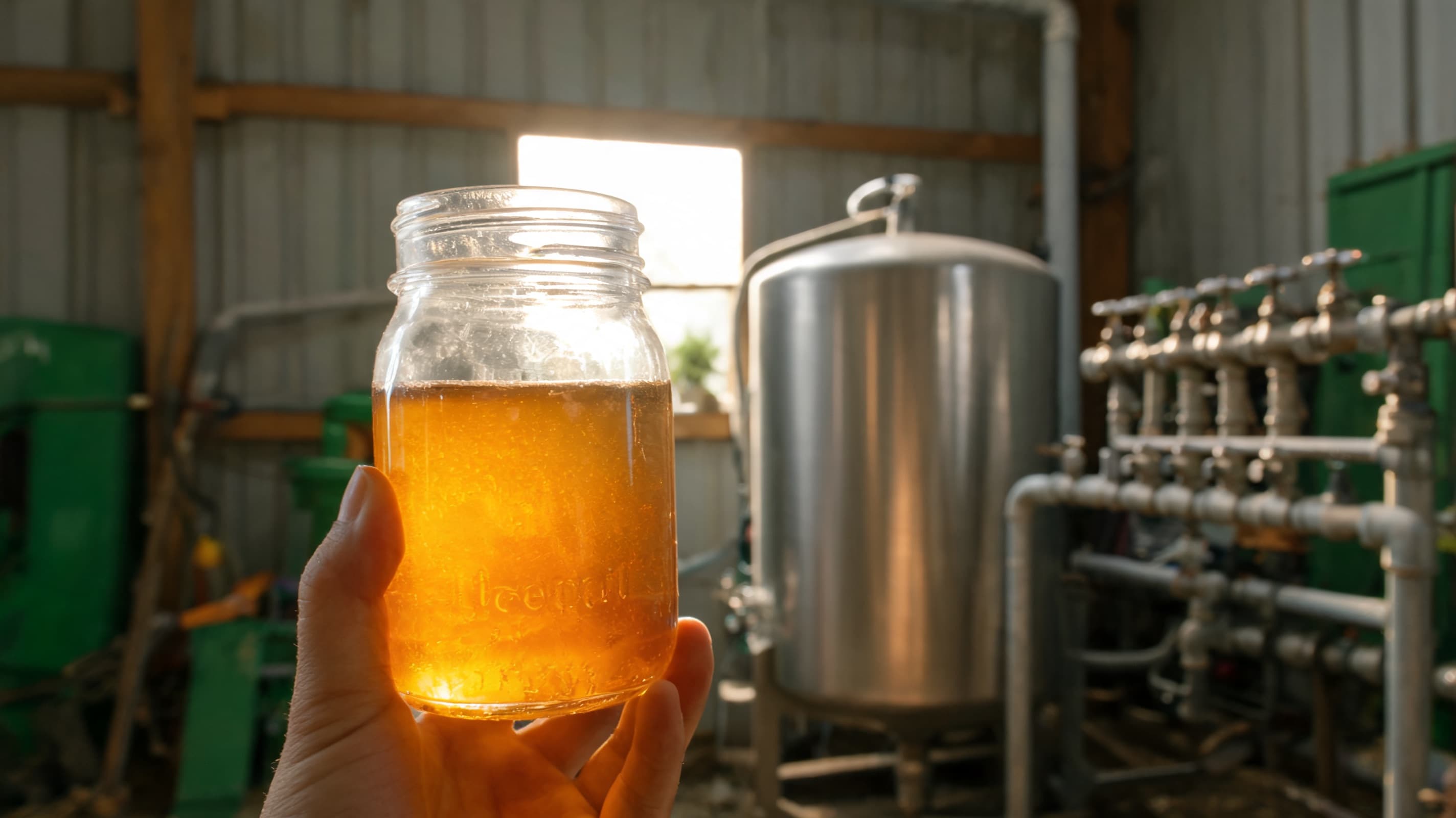
This test is the most practical tool available on tank compatibility. It can be done in the field with no laboratory equipment and shows you the result without risking the whole tank.
How to do it:
- Take a clean, transparent jar. Glass is preferable because you can see inside clearly. A volume of about 1 litre is suitable.
- Fill the jar with the water you will use in the field. This matters. Not tap water or bottled water, but the water you actually irrigate with. Water quality is part of the result.
- Add the products in exactly the same proportion you will use in the tank. For example, if you will put 2 kg into a 1000-litre tank, you put 2 grams into 1 litre. If the ratio is not preserved, the test loses its meaning.
- Add the products in the same order you will add them to the tank. Stir after each addition.
- Close the lid and shake for 10 to 15 seconds.
- Wait 15 minutes and look. Then wait another 30 minutes and look again. Some precipitation develops slowly; a mixture that looks clear in the first five minutes may produce sediment half an hour later.
What to look for:
- Sediment or precipitate at the bottom means the mixture is incompatible.
- Cloudiness or a milky appearance is a sign that precipitation is starting.
- An oil layer or separation on the surface indicates emulsion breaking.
- Gelling or thickening is physical incompatibility.
- Excessive foam or heating is a sign of reaction.
- A clear, homogeneous, sediment-free appearance indicates the mixture is usable.
Repeat the jar test whenever you try a new product combination, when your water source changes, and at seasonal transitions when water temperature changes markedly. Solubility falls in cold water; a mixture that works fine in winter may behave differently in summer, or the reverse.
The water itself is an ingredient
The most overlooked party in any tank compatibility discussion is the irrigation water. Water is the largest component of the mixture and it is not a neutral liquid.
Three values deserve attention:
- Hardness (calcium and magnesium content). Hard water already contains a high level of calcium. When you add sulphate or phosphate to that water, precipitation can begin even if you put no calcium in the tank at all.
- Bicarbonate level. High bicarbonate pulls the mixture's pH upward, affects chelate stability and leads to lime build-up in drippers.
- pH. The starting pH of the water determines how the products you add will behave.
Irrigation water analysis is therefore as important as soil analysis. You can find detailed information on water salinity and ion balance in our saline soil and high EC article. How to read your soil analysis report is covered in a separate guide.
Common mistakes
- Skipping the jar test. A five-minute test is always cheaper than a clogged drip line.
- Adding concentrates directly to one another. When products meet without being diluted in water, very high local concentrations form and the reaction begins.
- Putting product into an empty tank. The tank is filled halfway with water first.
- Running the test with different water. The test water must be the water used in the field.
- Letting the mixture stand. A prepared mixture should be used the same day. Precipitation and separation develop in a standing mixture.
- Not flushing the system. Flushing the line with clean water at the end of an application prevents residue build-up and clogging.
- Trusting habit instead of the label. Every product has its own technical data sheet and it overrides general rules.
Frequently Asked Questions
Which fertilisers cannot be mixed together? The most critical rule concerns calcium. Calcium-containing products should not be combined in the same tank with sulphate-containing products (calcium sulphate precipitation) or phosphate-containing products (calcium phosphate precipitation). Products containing humic acid are not mixed with acidifiers or calcium sources. Chelated micronutrients are risky with solutions containing high levels of phosphate and with strong acid or alkaline products. Always consult the product label and run a jar test before deciding.
Can calcium nitrate and magnesium sulphate go in the same tank? They should not. The calcium in calcium nitrate and the sulphate in magnesium sulphate combine to form calcium sulphate, which is very poorly soluble in water. A white, gritty precipitate appears in the tank, part of both elements fails to reach the plant, and drippers may clog. Both products can appear in the programme, but they must be delivered in separate tanks or separate applications.
How is a jar test done for a fertiliser mixture? Put about 1 litre of the irrigation water you use in the field into a clean glass jar. Add the products in the same proportion and the same order as in the tank, stirring after each addition. Close the lid and shake for 10 to 15 seconds. Check after 15 minutes and again after a further 30 minutes. If you see sediment at the bottom, cloudiness, gelling, an oil layer on the surface or excessive foam, the mixture is incompatible.
What should you do if precipitation occurs in the tank? Do not send the precipitated mixture into the system; clogged drippers and filters cost far more than the lost fertiliser. Empty the mixture and flush the tank and lines thoroughly with clean water. Then apply the products separately or move to a two-tank arrangement. Always run a jar test before trying the same combination again.
Why does mixing order matter? When products enter the tank in the wrong order, concentrated zones form that have not yet been sufficiently diluted, and the reaction starts in those zones. The correct approach is to fill the tank halfway with water and start the agitator, then add each product in turn as a pre-solution prepared in a separate bucket. Do not add the next product before the previous one has fully dissolved.
Conclusion
The tank mix is the least discussed stage of a fertiliser programme and the one that creates the most loss. Putting two incompatible products in the same bucket can quietly invalidate a well-built nutrition plan.
Three things to remember: keep calcium away from sulphate and phosphate, fill the tank with water first and add products in order as pre-solutions, and run a jar test before moving to any new combination.
If you are unsure about using the products in your programme together, review each product's technical data sheet and write to us via our contact page if needed. You can find our product groups and their contents on our products page.