How to Apply Calcium Nitrate: A Guide to Drip and Foliar Application
Calcium nitrate is one of the most widely used water-soluble fertilizers in modern vegetable and fruit production. Calcium nitrate is a highly water-soluble fertilizer that combines calcium (Ca) and nitrate-form nitrogen (NO₃-N) in a single product. Supplying both nutrients at once makes it practical for drip irrigation and foliar feeding.
But calcium nitrate only works when it is applied correctly. The wrong mix, wrong timing, or wrong dose wastes product and can clog drip lines. This guide explains what calcium nitrate does, how to apply it through drip and foliar methods, which crops need it, and the most common mistakes — from an agronomist's perspective.
What Does Calcium Nitrate Do?
Calcium is the building block of the plant cell wall. When a plant cannot take up enough calcium, cell walls weaken, leading to a range of physiological problems in fruit and foliage.
The main roles of calcium nitrate in the plant are:
- Cell wall strength — supports fruit firmness and shelf life.
- Prevention of blossom end rot — the darkened, sunken spot on the bottom of tomatoes, peppers, and watermelons is linked to calcium deficiency.
- A fast nitrogen source — nitrate nitrogen is taken up directly by the plant and supports vegetative growth.
- Reduced fruit cracking — helps lower cracking risk by strengthening skin tissue.
The most critical property of calcium is that it is immobile within the plant. Calcium cannot move from old tissue to young tissue inside the plant, which is why deficiency appears first in growing tips and young fruit. For this reason, calcium must be supplied continuously and regularly throughout the demand period.
Calcium Nitrate via Drip (Fertigation)
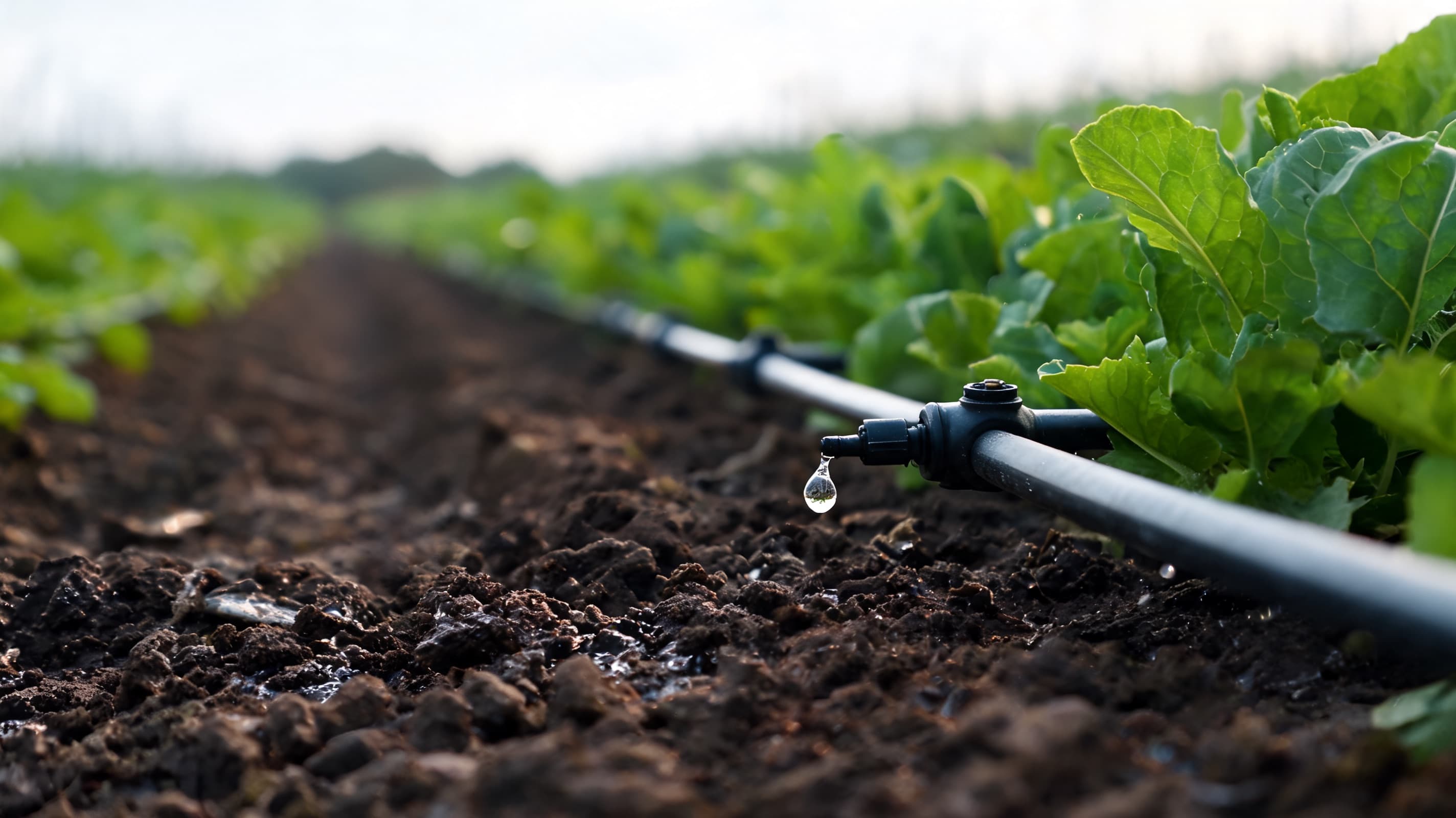
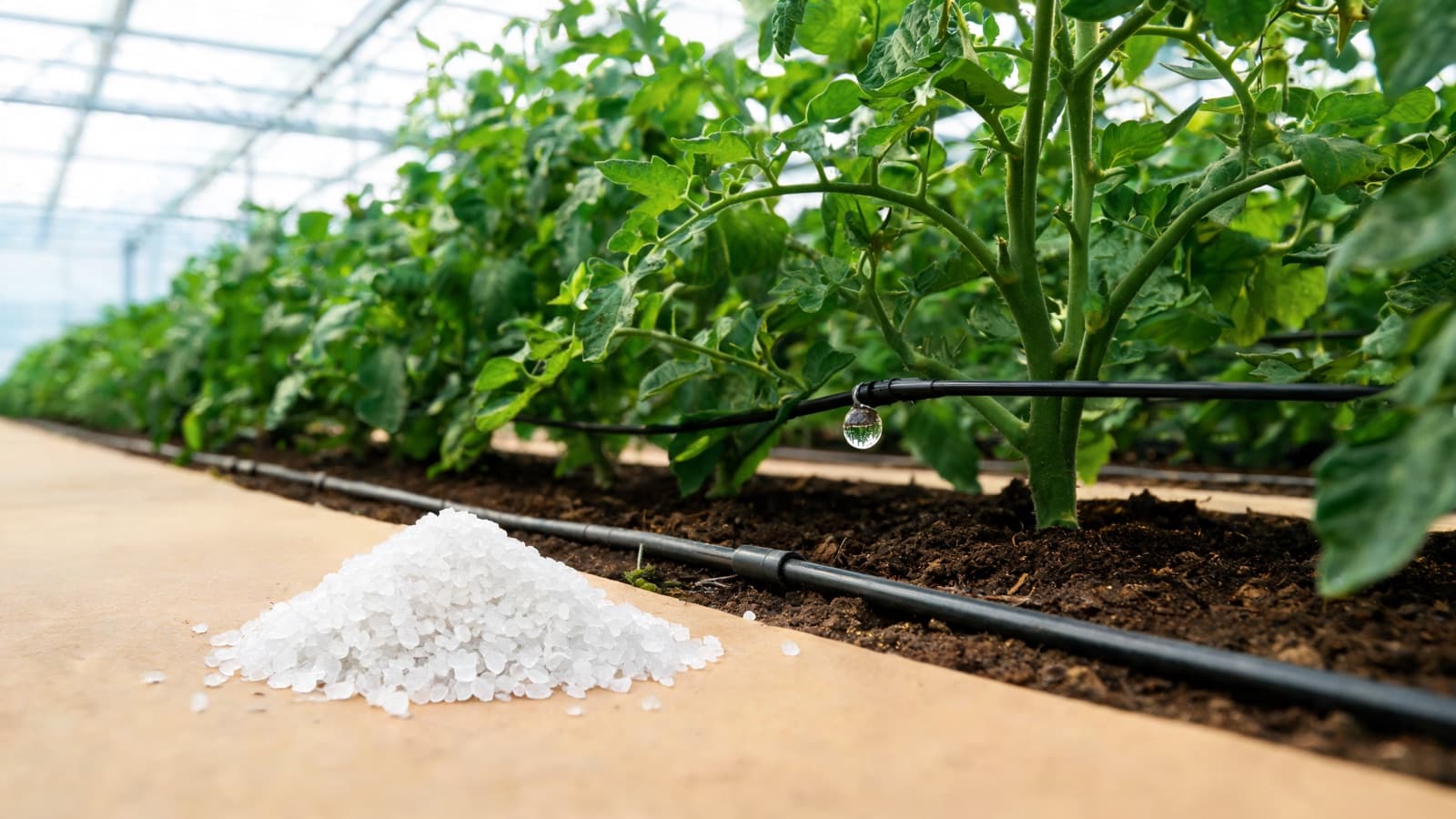
Drip irrigation is the most efficient way to deliver calcium nitrate to the root zone in a steady, controlled manner. Water-soluble flake calcium nitrate is suitable for drip systems.
Core steps for drip application
- Keep a separate stock tank. Always dissolve calcium nitrate in its own stock tank. Do not combine it in the same tank with phosphate- or sulfate-containing fertilizers (see the compatibility section).
- Dissolve fully in water. Dissolve the flake product completely in clean water; undissolved particles clog emitters.
- Monitor EC and pH. Tracking EC and pH in drip solutions is important for maintaining nutrient balance. Target values vary by crop and soil.
- Spread across the irrigation cycle. Inject the fertilizer in the middle of the irrigation set, with clean water flushing at the start and end.
- Follow the label and soil analysis for dose. The specific dose depends on soil analysis, crop, and growth stage. To determine the correct dose, follow the instructions on the product label and consult an agronomist based on your soil analysis.
Markka Genetik's Master Comp Calcium Nitrate is a flake-form calcium nitrate source containing 26% CaO and 15% total nitrogen (14.5% nitrate), used in fertigation applications.
Calcium Nitrate via Foliar Application
Foliar application is a supportive method for critical periods when calcium deficiency appears quickly — especially during flowering and fruit set. Because calcium moves slowly when taken up through the roots, foliar feeding plays a complementary role at moments of rapid demand.
What to watch in foliar application
- Apply during cooler hours. Early morning or late afternoon is ideal; midday heat increases leaf-burn risk.
- Achieve good coverage. The solution should coat both the upper and lower leaf surfaces in fine droplets.
- Target flowers and young fruit. Because calcium is immobile, reaching the organ you want to protect directly matters.
- Check compatibility before tank-mixing. There is a real risk when mixing with phosphate- and sulfate-containing tanks.
Markka Genetik's Calciphine is a three-component formulation containing calcium (15% CaO), nitrate nitrogen (8%), and boron (0.15%). Because boron supports calcium transport within the plant, this combination is preferred during flowering and fruit set.
Quick rule: Calcium reaches the plant slowly through the roots and quickly to the target through the leaf. In critical periods, the two methods complement each other.
Which Crops Use Calcium Nitrate?
Calcium nitrate is widely used in calcium-sensitive crops:
| Crop group | Typical problem | Role of calcium |
|---|---|---|
| Tomato, pepper, eggplant | Blossom end rot | Protects fruit-tip tissue |
| Watermelon, melon | Internal rot, cracking | Supports rind and flesh strength |
| Apple, pear | Bitter pit | Calcium distribution in flesh |
| Lettuce, cabbage | Inner leaf tip burn | Protects young leaf tissue |
| Strawberry | Leaf-tip burn, softening | Cell wall and firmness |
| Grape | Berry cracking, rot | Berry skin strength |
Each crop has different calcium needs and timing. To build the right program, the crop type, growth stage, and soil analysis must be evaluated together.
Compatibility: What Not to Mix Calcium Nitrate With
This is the most critical technical rule of calcium nitrate application. Do not mix calcium nitrate in the same stock tank or concentrated solution with fertilizers containing sulfate or phosphate.
The reason is chemical:
- Calcium + sulfate → forms a calcium sulfate (gypsum) precipitate.
- Calcium + phosphate → forms a calcium phosphate precipitate.
These precipitates do not dissolve in water. As a result, the nutrient cannot reach the plant, and emitters and filters become clogged. This is why, in modern fertigation systems, calcium sources are always kept in a separate stock tank (usually "Tank A"), while sulfate and phosphate sources are kept in another tank (usually "Tank B").
Practical rule: Do not combine calcium nitrate in the same concentrate tank with magnesium sulfate (Epsom salt), monoammonium phosphate (MAP), monopotassium phosphate (MKP), or phosphoric acid solutions.
Common Mistakes
- Using a single tank. Combining all fertilizers in one concentrate tank causes precipitation and clogging.
- Insufficient dissolving. Injecting undissolved flake into the system clogs emitters.
- Foliar application in midday heat. Creates leaf-burn and poor-absorption risk.
- Applying only in a crisis. Because calcium is immobile, a one-off boost will not correct a deficiency; a regular program is needed.
- Guessing the dose. A by-eye dose without soil analysis raises both deficiency and over-salinity risk.
- Skipping pH and EC monitoring. An uncontrolled solution can disrupt nutrient balance and root health.
Frequently Asked Questions
When should calcium nitrate be applied? It is applied regularly during periods of high calcium demand — especially rapid vegetative growth, flowering, and fruit set. Because calcium is immobile within the plant, continuous supply throughout the period is recommended rather than a single application.
Should calcium nitrate be applied by drip or foliar? Both are possible and often complementary. Drip provides steady nutrition to the root zone; foliar application gives fast support to the target organ during critical periods.
Can I mix calcium nitrate with other fertilizers? It should not be mixed in the same concentrate tank with most fertilizers. In particular, combining it with sulfate- or phosphate-containing fertilizers forms insoluble precipitates. Keep calcium sources in a separate stock tank.
Does calcium nitrate prevent blossom end rot? Blossom end rot is mostly linked to insufficient calcium reaching the fruit. Regular calcium feeding helps reduce the risk, although factors such as irrigation regularity and salinity also play a role.
What should the calcium nitrate dose be? The dose depends on crop type, growth stage, and soil analysis. Follow the instructions on the product label and consult an agronomist.
Conclusion
Because it delivers both calcium and nitrate nitrogen in a single product, calcium nitrate is one of the core fertilizers of modern vegetable and fruit production. Applying it correctly comes down to three rules: dissolve it fully in water, keep it in a separate tank from sulfate and phosphate sources, and supply it through a regular program.
Markka Genetik offers solutions for both drip and foliar needs with its calcium nitrate products registered with the Republic of Türkiye Ministry of Agriculture and Forestry (Master Comp Calcium Nitrate and Calciphine).
For a calcium feeding program suited to your crop and soil, you can request advice from our agronomists, ask for our catalog to review the products, or request a sample.