Tomato Blossom Drop — 5 Causes and Practical Solutions
When a grower walks the field and sees yellow flowers accumulated under the vine, they know that part of the season's yield potential has already fallen to the ground. Blossom drop — sometimes called flower abortion — is one of the most common physiological problems causing yield loss in tomato production.
Whether open-field or greenhouse, every tomato grower encounters this problem at some point. It is rarely caused by a single factor. Usually 2-3 factors combine. Correct diagnosis determines whether intervention reaches the fruiting stage in time.
This guide explains the 5 main causes of tomato blossom drop and practical solutions for each — drawing on Markka Genetik R&D's field experience and literature references.
Flower and Fruit Set Process in Tomato
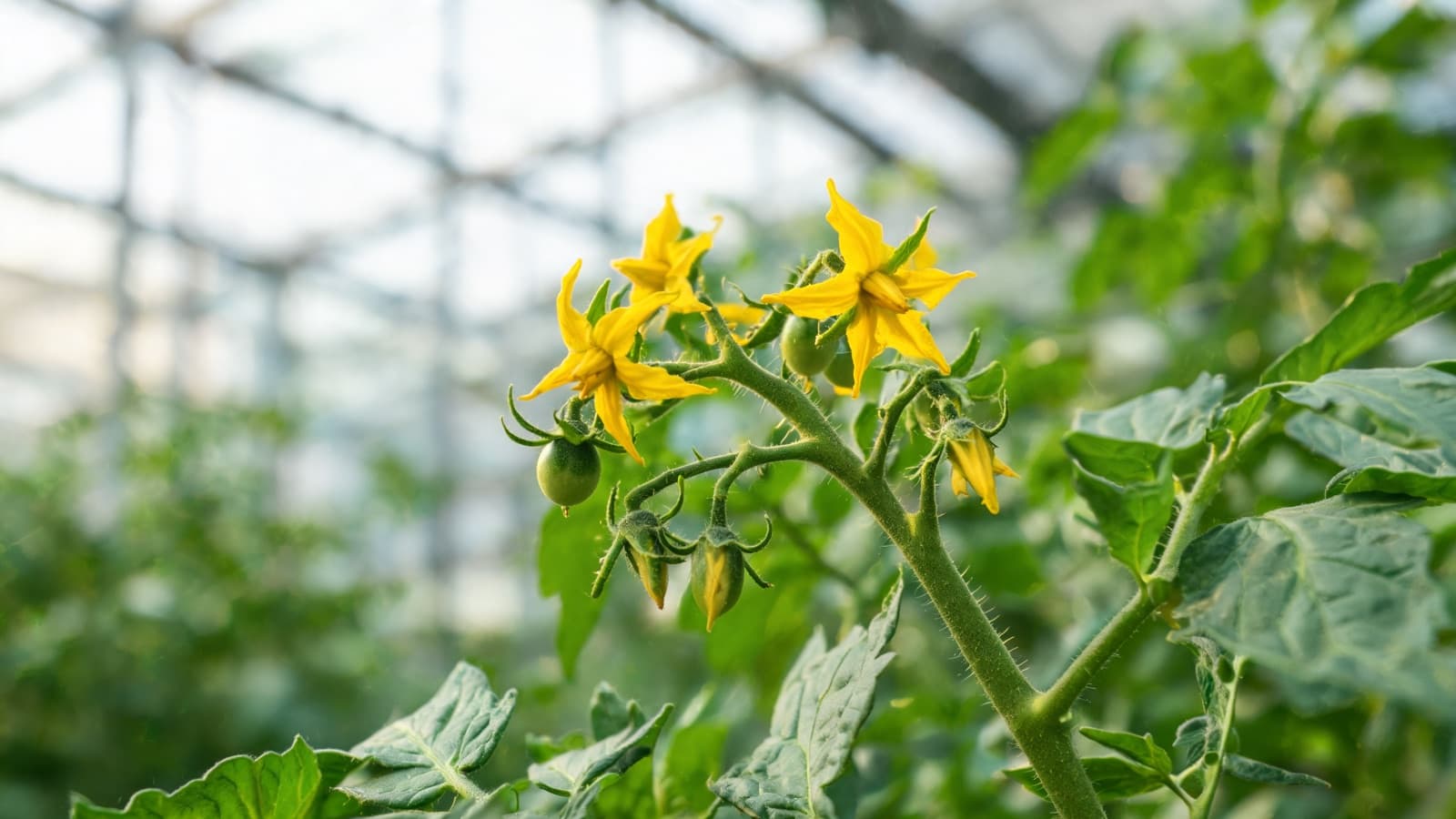
Before solutions, the biology must be understood. Flower set in a tomato plant passes through 4 stages:
- Flower bud formation — clustered raceme, 5-12 flowers per cluster
- Flower opening — in morning hours, 1-3 days
- Pollination — pollen reaching stigma (wind, insects, bumblebees, mechanical vibration)
- Fertilization and fruit formation — if pollination succeeds, ovary swells, fruit forms
If any link in this chain breaks, the flower does not become fruit — drop occurs from the stem base. Now let us examine the 5 main breakpoints.
1. Temperature and Humidity Stress
The most common cause. Tomato pollen quality is highly sensitive to temperature.
Critical Thresholds
- Day temperature above 32°C: Pollen sterility increases
- Night temperature above 20°C: Pollen production decreases
- Humidity above 70%: Pollen sticks and fails to disperse
- Humidity below 30%: Pollen dries and cannot attach to stigma
In Mediterranean climates (Spanish, Turkish, Italian growing areas), the combination of 35-40°C summer temperatures and high humidity (75-85%) is the peak period for blossom drop.
Solutions
- Greenhouse ventilation: Top vents and side openings must provide air circulation; day temperature should not exceed 28°C
- Pollen vibration / auxiliary pollinators: Manual vibrators or bumblebee hives are critical where natural pollination is weak
- Night cooling: Greenhouse temperature must drop to 18-20°C overnight
- Shading: In hot summer periods, 30% shade netting
Blossom drop caused by temperature stress cannot be solved by fertilization alone — climate control comes first.
2. Boron (B) Deficiency
Boron is the essential micro-element of flower structure and pollen tube growth. Under boron deficiency:
- Flower stalks weaken, breaking at the base
- Pollen production decreases
- Pollen tubes fail to elongate from stigma to ovary
- Even when fruit forms, darkening and cracking starting from the tip may appear
Symptom Recognition
- Deformation, thickening at leaf tips
- Short internodes on young leaves
- Flower buds dropping before opening
- Vertical cracking on fruit
Solutions
- Foliar application: Boron + magnesium (B-Mg) combined products at 200 g per 100 L during flowering
- Soil application: Boron-containing compound fertilizer at season start, or borax (limited quantity — toxicity at excess!)
- Markka equivalent: Markka Master B-Mg formulation, Aventus (NPK + micro element)
Warning: Boron's toxicity threshold lies very close to its sufficiency threshold. Excess boron (2-3x label dose) causes leaf burn. Stick to label dose.
3. Calcium (Ca) Deficiency
Calcium is the building block of cell walls. From flower stalks to fruit skin, all tissue integrity depends on calcium.
Symptom Recognition
- Blossom End Rot (BER): Darkened, sunken area at the bottom tip of the fruit. Classic calcium deficiency symptom
- Flower stalks breaking easily
- Curling, deformation of young leaves
- Stubby, weak root development
Why Fertilization Alone Is Not Enough?
Calcium moves only through the xylem (water transport) system within the plant, not through the phloem (return) system. This means:
- Without adequate water transpiration (stomata closed in heat), calcium cannot be carried to fruit
- Calcium is not stored in the plant; continuous new uptake is required
- Even with plenty of calcium in the soil, symptoms persist if water stress exists
Solutions
- Continuous calcium via drip irrigation: Liquid calcium such as Calciphine or Maxxim Plus, supplied continuously through drip
- Foliar calcium: For acute symptoms, rapid correction — 200-300 g per 100 L
- Water management: Regular irrigation (no stress, then shock = calcium imbalance)
- Soil structure: Calcium + organic matter + humic acid combination is the long-term solution
- Markka equivalent: Calciphine, Maxxim Plus, Pascal Plus, Phoscal K, Agrical
The primary solution to calcium deficiency is not fertilizer — it is water and transpiration management. Fertilizer is supportive, not the cure.
4. Excessive or Wrong Nitrogen Application
A frequently overlooked cause of blossom drop is excessive nitrogen application. Nitrogen drives the plant into vegetative growth — leaf and stem development. During flowering, excess nitrogen causes:
- The plant remains in "vegetative mode," diverting energy from flowers to leaf growth
- Pollen quality drops
- Flower set fails
Symptom Recognition
- Excessive green, dark leaf color
- Plant appearing "too lush"
- Abundant leaves on side shoots, few flowers
- Few flowers per cluster
Solutions
- Shift N-K ratio toward 1:2 during flowering — potassium dominant
- If 20-20-20 is used in the vegetative stage, transition to flowering-stage P+K-dominant formulas such as 15-30-15 or 12-12-36
- Reduce drip N dose, increase phosphorus and potassium
- Markka equivalent: Master Big Bang 21, Master Potassium Nitrate, Markka MKP, VIP K-31
5. Pollination Deficiency
In natural conditions, tomato is a self-pollinating plant via wind and vibration. But in modern greenhouse conditions:
- No wind
- Limited natural insect passage
- Flowers open, but pollination does not occur
Result: flower set fails, drop occurs.
Symptoms
- Flowers open fully but drop within 2-3 days without fruit formation
- Stigma structure normal, pollen production present, but transfer absent
- No problem in open-field conditions (with wind)
Solutions
- Bumblebee hives: The gold standard of modern greenhouse production. 1 hive per 1000 m²
- Manual vibration tool: Back-mounted, 2-3 seconds vibration per cluster
- Air circulation: Light air flow with fans provides natural vibration effect
- Biostimulant support: Algisea (seaweed) and Diamente (amino acid) support flower cluster integrity and pollen quality
Diagnostic Flowchart — Which Problem During the Season?
Symptoms may look similar though the underlying cause differs. For rapid diagnosis:
| Symptom | Likely Cause | First Action |
|---|---|---|
| Flowers open then drop within 1-2 days | Pollination deficiency | Bumblebee + vibration |
| Flowers dropping in bud stage | Boron deficiency | Foliar boron application |
| Fruit forms but bottom rots | Calcium + water stress | Drip Ca + regular irrigation |
| Abundant leaves, few flowers | Excessive nitrogen | NPK ratio review |
| Mid-summer drops intensified | Temperature + humidity stress | Greenhouse ventilation + shading |
Seasonal Program to Prevent Blossom Drop
Vegetative stage (seedling to pre-flowering):
- Balanced NPK (20-20-20 or similar)
- Soil rehabilitation with humic/fulvic acid (Doca-22, Nexxus)
- Micro-element profile check
Flowering start (1st cluster):
- Foliar B + Mg application (Markka Master B-Mg)
- Liquid calcium via drip (Calciphine)
- N:K ratio shift to 1:1.5
Full flowering stage:
- Bumblebees or vibration active
- Continuous Ca via drip (Maxxim Plus)
- Biostimulant support (Algisea, Diamente)
- Greenhouse humidity 60-75% range
- Greenhouse temperature below 28°C
Fruit growth stage:
- K-dominant program (Master Potassium Nitrate, VIP K-31)
- Regular irrigation (no stress)
- Micro-element monitoring (especially Fe, Zn)
The Markka Genetik Approach
Tomato blossom drop accounts for 30% of consultation requests at Markka. Our 20+ years of production experience in Antalya show that this problem cannot be solved by a single fertilizer — climate, water, fertilizer, biostimulant, and mechanical intervention must be addressed as a whole.
Products such as Calciphine, Maxxim Plus, Master Calcium Nitrate, and Master B-Mg are our frontline solution set against blossom drop. But these will not deliver the expected result without correct climate and water management.
Our Turkish Ministry of Agriculture-registered production line keeps all Ca and B category products continuously in stock for integration into greenhouse seasonal programs.
Seasonal planning consultation: [email protected] · WhatsApp +90 242 424 82 91
Frequently Asked Questions
Is one fertilizer enough for blossom drop? No. The cause is multifactorial. A balanced calcium + boron + potassium program — combined with climate and irrigation control — produces results. A single fertilizer is not the solution.
Foliar fertilizer or drip irrigation — which acts faster? For urgent intervention, foliar fertilizer shows symptoms within 7-10 days. Drip irrigation provides continuous, sustainable calcium. The ideal approach uses both together: foliar for acute correction, drip for continuity.
Is pollination possible in tomato without bumblebee hives? In open fields, yes — wind suffices. In greenhouses, manual vibration (back-mounted tool, 2-3 seconds per cluster once or twice daily) is workable. Bumblebees are more efficient but not mandatory.
If blossom drop is temperature-related, what can I do? Greenhouse ventilation, shading, night cooling, irrigation discipline — all climate management tools. If air temperature alone exceeds 35°C, the plant experiences pollen sterilization that no fertilizer can compensate for. In this case, climate management is the priority.
Is Blossom End Rot (BER) the same as blossom drop? No, but their causes overlap. BER is the rotting of the fruit tip from calcium deficiency after fruit has set. Blossom drop is the loss of flowers before fruit forms. Both are linked to calcium and water management — but in BER there is fruit, in blossom drop there is not.
Can NPK + micro element combination products like Aventus solve blossom drop alone? Aventus is a flowering-stage foliar product with balanced NPK + boron + magnesium. It provides adequate support in most blossom drop cases — but if the cause is climate or pollination, fertilizer alone is not the solution. Diagnose first, intervene second.
Can liquid calcium (Calciphine) be applied to soil? Calciphine is designed for fertigation (drip). Surface soil application is possible but less effective than drip due to calcium's immobility. In emergencies, it can also be used as foliar.
Conclusion
Tomato blossom drop is not solely a fertilizer deficiency issue. Temperature, humidity, pollen quality, calcium, boron, nitrogen balance, and irrigation discipline must be addressed together. Correct diagnosis + timely intervention = preservation of the season's yield target.
Markka Genetik continues to stand by greenhouse growers in the fight against blossom drop. Tomato, pepper, cucumber, eggplant — in the four foundational crops of Mediterranean greenhouse agriculture, the success of the flowering season is the foundation of the annual yield.
Markka products against blossom drop: markkagenetik.com.tr/products?category=calcium